In March 2026, a team from the Mohamed bin Zayed Raptor Conservation Fund returned to Madagascar’s Alley of the Baobabs for the second consecutive year, working alongside The Peregrine Fund Madagascar in one of the most ambitious raptor conservation partnerships in the region. The mission: capture and satellite tag Sooty Falcons on their wintering grounds and trace their journeys back to the breeding colonies where they were born.
The Sooty Falcon is a bird built for speed and distance. It breeds across the deserts and islands of the Middle East and North Africa, then flies thousands of kilometres south to spend the non-breeding season in Madagascar. Classified as Vulnerable on the IUCN Red List, its population is in decline. And yet, for a species found in 29 countries, remarkably little is known about the forces driving that decline.
For ten days, our joint MBZRCF and Peregrine Fund team set mist nets among the towering Grandidier’s baobabs where the falcons roost, working from dawn to dusk in the Menabe region’s dry heat. Five Sooty Falcons were successfully trapped, measured, blood sampled, and fitted with satellite transmitters before being released. Blood samples from all five birds will be exported to Abu Dhabi for a genomic study investigating population structure, the core objective of the project. This brings our total to 14 tagged birds across two field seasons.
We also trialled something new. The first two birds received the same backpack transmitters used in 2025, but the remaining three were fitted with Druid satellite units attached via a pelvic mount, a method that positions the device closer to the bird’s centre of gravity and may reduce interference with flight.
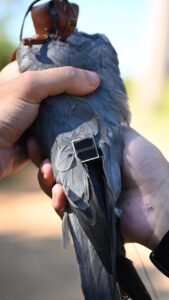
The tracking data from 2025 had already revealed extraordinary journeys. Birds tagged at the Alley of the Baobabs migrated to breeding grounds along the Red Sea, in Oman, Egypt, and deep into the Sahel in Libya, covering over 5,600 kilometres. But the data also raised concern. Several transmitters went silent in the Ethiopia corridor, a region where intensive pesticide spraying for quelea and locust control may be threatening the birds during migration.
This year’s fieldwork brought its own sobering observations. The number of Sooty Falcons at the Alley of the Baobabs had dropped from an estimated 120 birds in 2025 to roughly 40. Whether this reflects a genuine population decline, a shift in wintering distribution, or simply the natural variation of a two-week snapshot remains an open question. Tracking data show that wintering birds move around within Madagascar, so a full-season survey would be needed to know for certain.
Perhaps the most troubling moment came during the release of one newly tagged bird. Sooty 4, fitted with a Druid transmitter via pelvic mount, was immediately and aggressively pursued by at least eight other Sooty Falcons at the roost site. The attack was sustained and intense. The other birds appeared to perceive the tagged falcon as alien, as something unfamiliar in their midst. Whether it was the altered silhouette, a change in flight profile, or something else entirely, the response was clear: a freshly released bird under sustained assault from its own species. We are not aware of this kind of reaction being documented before in tagged raptors, and it raises real questions about what transmitters may be doing to the birds that carry them.
Of the nine birds tagged in 2025, only two returned to Madagascar the following season. One of those subsequently died, possibly during a major cyclone. In February 2026, an intact transmitter was recovered on the ground in southern Ethiopia from another 2025 bird, likely predated. The mortality picture, combined with the aggression we witnessed, has prompted an honest internal conversation about whether the tags themselves may be imposing costs on the very species we are working to protect.
It is a conversation the wider raptor research community is already having. Gyrfalcon researchers in the US and Europe have placed a moratorium on tagging. A Saker Falcon programme was paused after similar concerns and has only recently resumed with a methodology designed to measure tagging impacts directly. We believe the Sooty Falcon deserves the same careful scrutiny.
The good news is that the primary objective of the tagging programme has been achieved. We now know where these wintering birds breed. That geographic framework is what the planned genomic study needs. Future sampling for genetics can proceed through blood and feather collection alone, without the need for further transmitter deployments.
None of this work would be possible without the partnership between the MBZRCF and The Peregrine Fund Madagascar. Dr Lily Arison Rene de Roland and his team managed every dimension of the fieldwork on the ground, from permits in Antananarivo to the daily logistics at the Baobabs. It is a collaboration built on trust, shared purpose, and a deep commitment to a bird that most of the world has never heard of.
The Sooty Falcon remains full of mysteries. We are committed to solving them, and to making sure we do no harm along the way.