Dr. Munir Virani, Chief Operating Officer of the Mohamed bin Zayed Raptor Conservation Fund, was invited as a plenary speaker at the 6th Society for Conservation Biology Asia Conference, held in Kathmandu in early June 2026. The gathering brought together hundreds of conservation scientists, students, practitioners, and policymakers from across the Asia region.
Dr. Virani shared the plenary stage with two distinguished colleagues. Dr. Darryl MacKenzie from New Zealand, a world authority on occupancy modelling, spoke about the statistical foundations that have shaped global conservation decisions. Professor Nawaz Ali from Pakistan’s Snow Leopard Foundation presented on snow leopard surveys in the high mountains of northern Pakistan, and on the rediscovery of the sand cat in the deserts of Qatar.
Dr. Virani’s plenary focused on the MBZRCF’s transformative work in Mongolia, where the Fund and its partners have tackled one of the most preventable and devastating threats facing raptors today: electrocution on power infrastructure. The presentation traced the journey from the silent loss of birds across the Mongolian steppe to the deployment of one of the largest raptor electrocution mitigation programmes in the world. Twenty-seven thousand power poles retrofitted. Raptor mortality reduced by ninety-five per cent. Nearly thirty thousand Saker Falcons fledged from artificial nest platforms raised across the landscape.
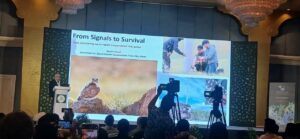
In a direct call to action, Dr. Virani challenged young conservationists across the Asia region to engage with their national utility companies. Raptor electrocution, he argued, is one of the few major conservation problems with a clear, scalable, and affordable solution. The science is well established. The engineering is straightforward. What is needed now is partnership and political will.
The plenary closed with a panel discussion moderated by Dr. Amit Mallick of the International Big Cat Alliance (IBCA), which broadened the conversation to cross-taxa monitoring and the integration of robust science into policy decisions across the region.
The MBZRCF’s Mongolia work received a sustained standing ovation, and Dr. Virani was approached throughout the remainder of the conference by young researchers, practitioners, and government representatives seeking advice, partnership, and mentorship. New friendships were forged. Several promising collaborations are now in active discussion, including potential extensions of the electrocution mitigation model to other countries in the region where the same threats persist.
Dr. Virani returned from Kathmandu with renewed conviction in the work and in the generation of young Asian conservationists ready to carry it forward.